

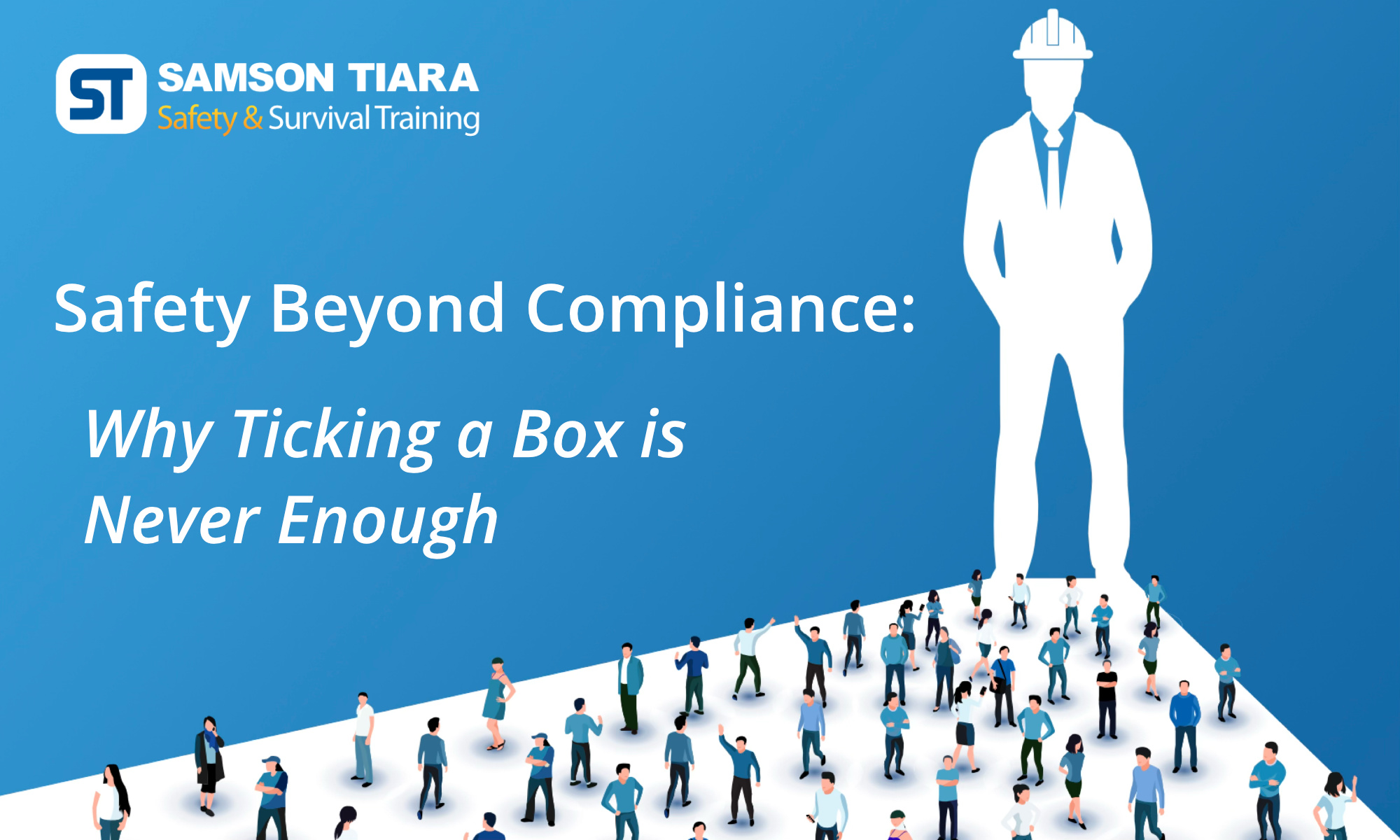
Compliance is the foundation of workplace safety, but it is not the building. If your organisation’s safety programme stops at ticking the regulatory box, you may be satisfying the auditor while quietly accumulating risk. This article aims to to explore why safety culture, and not just compliance alone, is what helps keep workers alive.
Compliance and Safety are Not the Same Thing
When discussing the topic of workplace safety, the conversation frequently begins, and often ends, with compliance. Did we pass the audit? Are we meeting all of the regulatory requirements? Have the certificates been issued? These questions matter. Compliance is important. It represents society’s agreed minimum standard for protecting workers, and without it, standards across industries would collapse.
But compliance is not the same thing as safety; One is the foundation upon which we build, while the other is the integrity of the structure itself. Compliance will tell us the minimum that is required to avoid a fine or to satisfy a government inspector. It ensures that a safety system exists. Safety, in the fullest sense, tells us whether that system actually works when it matters most: at two o’clock in the morning during a gas alarm, in the middle of a confined space entry when the atmosphere changes, in the moment of truth when a supervisor asks a worker to skip a procedure to save time.
Compliance will satisfy the audit, but it is safety that protects the person. These two things are not the same, and organisations that confuse the two will often pay a heavy price.
The Compliance Trap
In workplaces where safety has become a box-ticking exercise, a very predictable pattern typically emerges. In these workplaces training is only conducted to satisfy a regulatory requirement, rather than to build genuine competency amongst the workforce. Procedures are written, but they are rarely followed on the job site. Audits are passed, due in large part to advanced preparation, but as soon as the inspector leaves the workplace returns to how it normally operates.
Frequently in these workplaces, safety becomes something that workers prepare for before the auditors arrive and instead of being a reality that is lived every day. This is the uncomfortable truth that every safety professional must eventually face: you can be fully compliant and still have a serious accident tomorrow.
The gap between the written rules and procedures and the real behaviour on the ground is not a gap that paperwork alone can close. Only culture can close it.
What ‘Beyond Compliance’ Actually Looks Like
A genuine safety culture is not a thicker rulebook. It is not a longer induction or a bigger fine for violations. It is something far simpler and yet far harder to manufacture: it is the set of behaviours, values, and norms that determine how people act when no one is watching them.
A true safety culture exists when your team makes safe decisions even when they are under pressure to hit a deadline or to save a few extra dollars. It exists when the a junior worker feels confident enough to speak up, or to even stop work entirely, without fear of being dismissed, punished, or ignored. It exists when workers are actively looking out for the safety of their colleagues and not just fulfilling their own individual obligations.
Culture is what fills the gap between the written rule and the real situation, and critically, your culture is shaped by what your leaders do every day, and not by what policy documents say.
Leadership: Where Culture Starts and Where It Fails
In every organisation, whether performing well or not on safety, the culture begins with leadership. Workers are very adept at noticing the things their leaders actually care about. They will take note of what is asked about, what is ignored, and what is tolerated. These signals, more than any procedure, rule or clichéd safety poster on a break-room wall, determine how workers behave.
When a manager walks past a hazard without stopping, the team quickly learns that the hazard is acceptable. When a supervisor rewards a worker for completing a task quickly at the expense of safety, the team will learn that speed matters more than safety. When leadership celebrates the number of STOP cards issued rather than the quality of the observations and the corrective actions that follow, they have turned a life-saving tool into a creative writing exercise.
Conversely, when a leader stops a job to address a hazard, visibly and without irritation, the team learns that safety is real and not just theatrics. That single interaction, consistently repeated, builds the kind of culture that compliance alone can never achieve.
The concept is sometimes called the ‘shadow of the leader.’ It is the idea that the leader’s priorities, values, and behaviours cast a long shadow over the entire team. Safety culture is, in large part, a reflection of that shadow.
Hazard Identification: Closing the Gap Between Theory and Reality
One of the most fundamental safety activities, and one that is often compromised, is hazard identification. In theory, every worker understands that hazards should be identified and reported. In practice, however, hazards are often missed, ignored, or simply accepted as normal.
The danger is not that hazards exist, since hazards exist in every workplace, in every industry, and in every environment. The real danger is normalisation: the gradual process by which the repeated exposure to a hazard causes workers, and leaders alike, to stop seeing it as a threat. A small leak becomes part of the background, a bunch of boxes stacked at the emergency exit is normal, a piece of equipment that runs rough but ‘usually’ works is not worth raising.
A strong safety culture actively fights against normalisation. It creates an environment in which workers feel not just permitted, but actively encouraged, to raise concerns about conditions that ‘have always been like that.’ It treats every hazard report as valuable intelligence, a chance to improve, and not as a complaint or an inconvenience.
Near Misses: The Lessons You Cannot Afford to Ignore
Perhaps the most important difference between a compliant organisation and a genuinely safe organisation is how they handle near misses. A near miss, an event that could have caused injury, damage, or worse, but did not, is one of the most valuable things that can happen in a workplace. It is a warning, delivered before anyone was hurt.
In organisations with weak safety cultures, near misses are often categorised as ‘nothing happened’ and left unreported, uninvestigated, and unlearned from. In organisations with safety cultures, near misses are treated as exactly what they are: free and valuable lessons to be learned from. They are reported openly, investigated quickly, and are used to implement fixes before the next event causes an injury, a fatality, or a catastrophic incident.
The statistics are sobering: for every major workplace accident, there are dozens of serious incidents and hundreds of near misses that preceded it, all of them potential turning points at which intervention could have prevented the disastrous outcome. If your culture punishes or dismisses near-miss reporting as unnecessary, you are not eliminating those near misses. You are simply losing visibility of them. And the risk accumulates, invisible, until it is not.
Training: The Bridge Between Vision and Reality
Leadership vision without workforce competency is an aspiration, not a safety system. The most culturally committed organisation will still face unacceptable risk if its workers do not have the skills, knowledge, and practised behaviours essential to responding correctly when it matters.
This is why competency-based training, and not ‘tick-the-box’ training designed purely to satisfy a regulatory requirement, is the critical bridge between the safety culture a leadership team wants to build and the reality experienced by workers every day. When a worker has genuinely learned what to do in a helicopter ditching scenario, not just signed a form confirming they attended a briefing, they behave differently offshore. When a drilling team has practised well control procedures in a realistic simulator, not just read about them, they respond differently when a well kicks.
Safety culture cannot exist without skilled, trained, and competent people. Training done well does not just satisfy an auditor, it gives workers the understanding of why each procedure matters, the confidence to follow it under pressure, and the capability to recognise when something is wrong before it becomes irreversible.
The Real Test
When the audits are complete and the reports are filed, there is one question that, when asked, cuts through every compliance framework and policy document to reveal the truth about your safety culture: Would I be worried about the safety of a loved one if they worked here?
If the answer is no, then you are building or already have a positive safety culture. However, if the answer is yes, or if the question causes you a great deal of uncertainty or discomfort, then no amount of compliance will change the underlying risk.
‘Safety beyond compliance’ is not just a fancy slogan. It is a daily choice, made by leaders through their behaviour, made by workers through their actions, and built over time through the consistent application of genuine values. It is harder than compliance. It is also the only thing that actually works.
Samson Tiara is dedicated to improving the safety and well-being of all workers and provides a wide range of other safety training programmes. To find out more about the training we offer and what we can do to improve worker safety in your organisation, please feel free to contact us at:
Samson Tiara
The Garden Centre #6-03,
Kawasan Komersial Cilandak,
Jl. Raya Cilandak KKO,
Jakarta 12560, Indonesia
Phone: +62 21 780 1388
WhatsApp: +62 811 1767 985
Fax: +62 21 780 1389
Email: marketing@survival-systems.com
Website: http://www.samson-tiara.co.id
LinkedIn: https://www.linkedin.com/company/pt.-samson-tiara
* PT. Samson Tiara is 1 of 14 TEEX accredited training providers in the world.*
* PT. Samson Tiara is the first OPITO Approved Training Provider in Indonesia & winner of the 2016 OPITO training provider of the year.*
About The Author